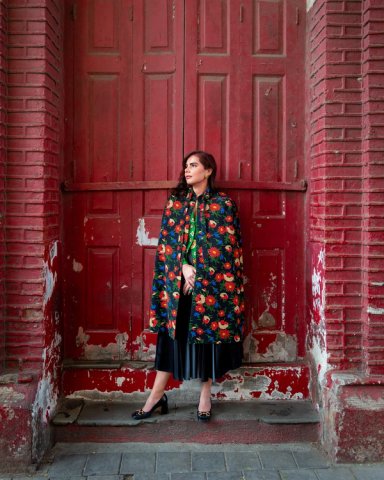
Panels Slide; Secret Doors Open; Sights Appear
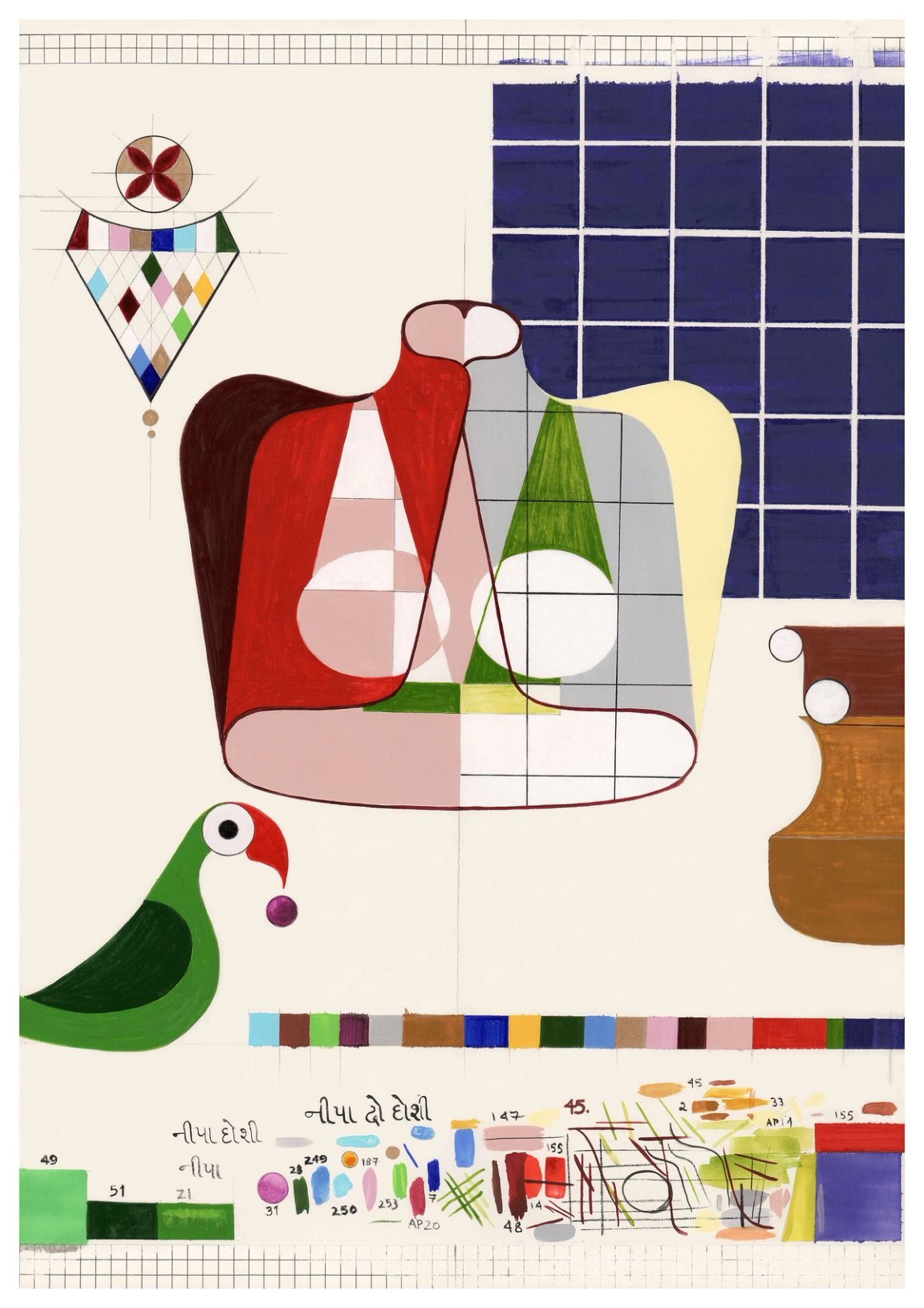
A self-portrait, drawn by Nipa Doshi
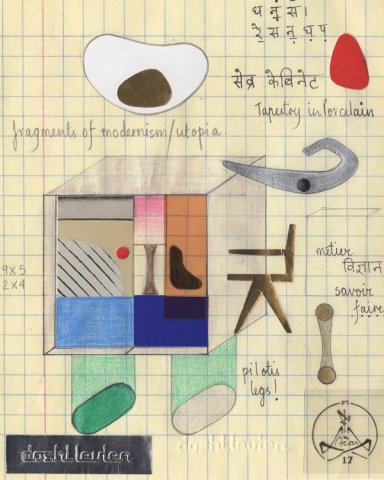
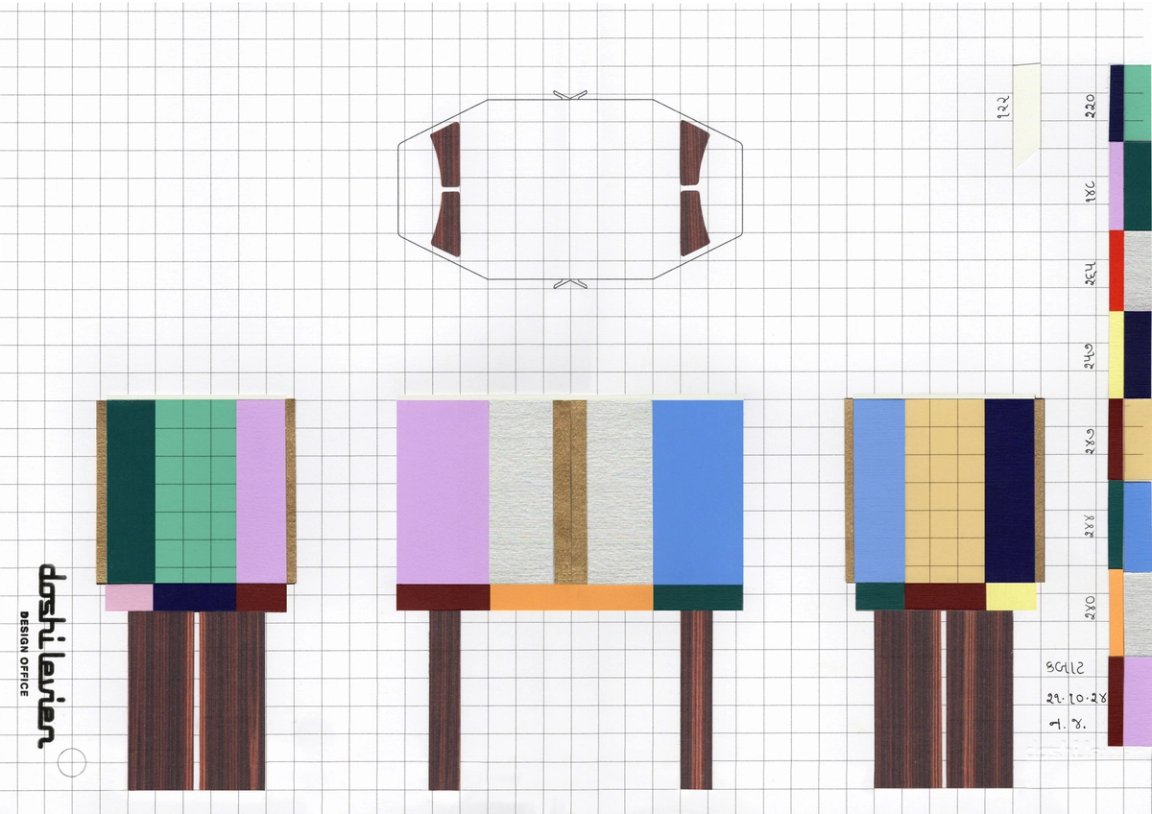
Nipa Doshi puts down a piece of graph paper, thickly embossed with the name of her design studio, Doshi Levien, on the table in front of us. Across its surface, different pieces of transparent acetate and painted card have been snipped out and pasted to the grid, collaged into a fragmented form that describes the shape of a cabinet in two dimensions. “It’s called a kaavad, which could almost be ‘cupboard’,” Doshi tells me. “It’s a kind of travelling shrine, filled with stories.”
Prior to meeting Doshi, surrounded by her drawings and collages in the Doshi Levien studio1 above London’s Columbia Road, I had never heard of a kaavad. In this, I am not alone. “The kaavad is one of the lesser-known forms of storytelling from Rajasthan,” writes artist and researcher Nina Sabnani, author of the 2014 study Kaavad Tradition Of Rajasthan: A Portable Pilgrimage. The kaavad, Sabnani explains, is a wooden cabinet reconceived as a space of worship, its form having been present in the northwest of India for around 400 years. “The Kaavad object brings together elements of pilgrimage, storytelling, identity and design,” she writes. “Its distinctive characteristic lies in its ability to negotiate place and space, the sacred and secular, myth and reality, time and memory.”
A kaavad is designed as a cabinet of doors within doors, whose intricate carpentry (ghadna) is emblazoned with dense paintings (maandna) of figures from mythic and religious tales. As these doors fold out from one another, hinging away from a central shrine, they reveal intricate tableaux of gods, heroes and everyday worshippers, all painted in block tones outlined in black, such that its stories “slowly and magically [appear] from a mass of flat colours.” The kaavad is laden with these stories, tens upon tens of them, yet is still small enough to be carried by a kaavadiya bhat, a travelling performer who recites its tales. The kaavadiya bhat unfurls their kaavad’s doors to people unable to make pilgrimage, in return for financial contributions that will ultimately see these worshippers painted into its narratives. “The Kaavad is not a replica of a shrine or temple; it is a temple that cannot be entered physically,” Sabnani writes. “Entry is made possible only through the agency of imagination and narration, in the present tense, by the storyteller.”
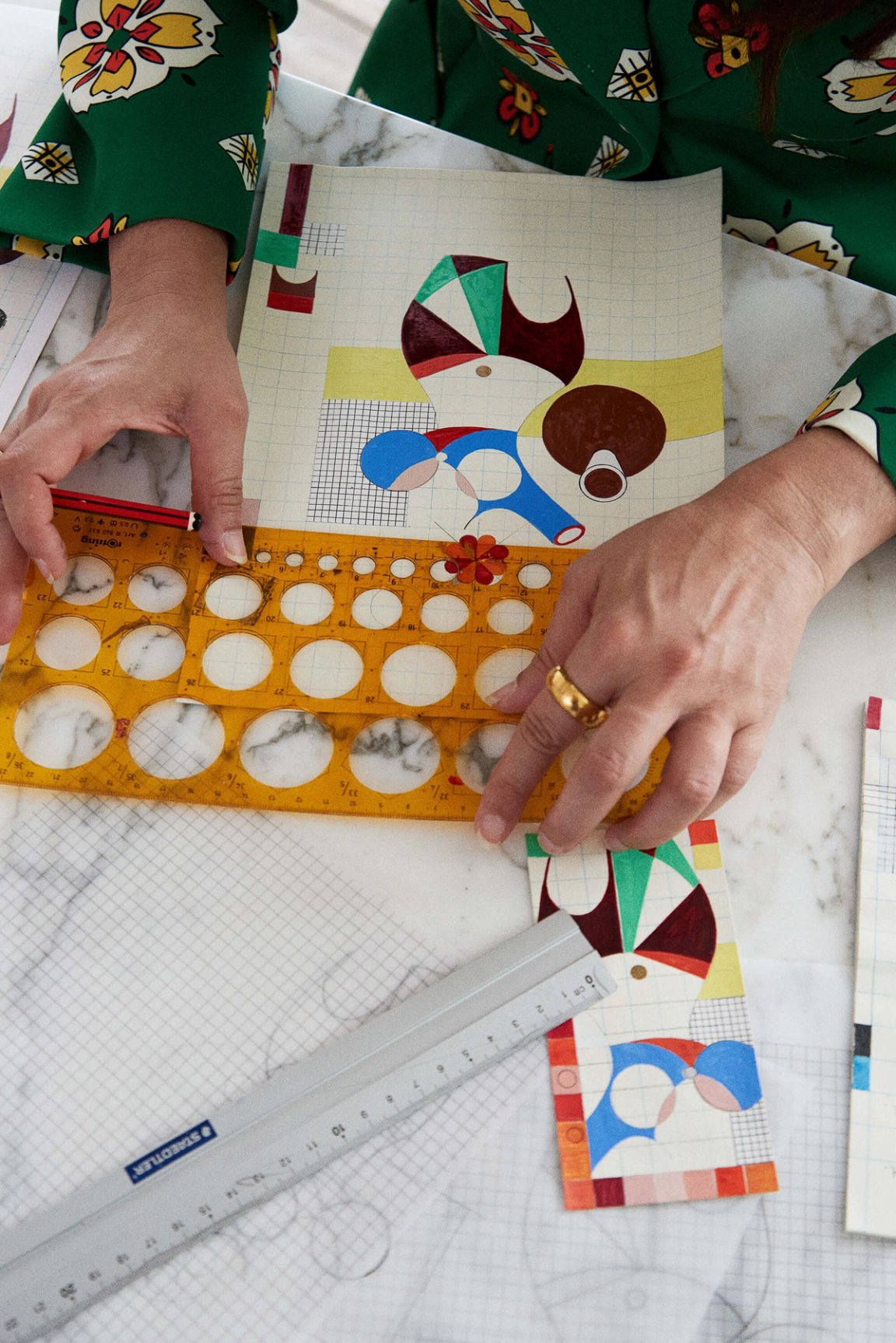
Doshi adding to a drawing that references actor Zeenat Aman.
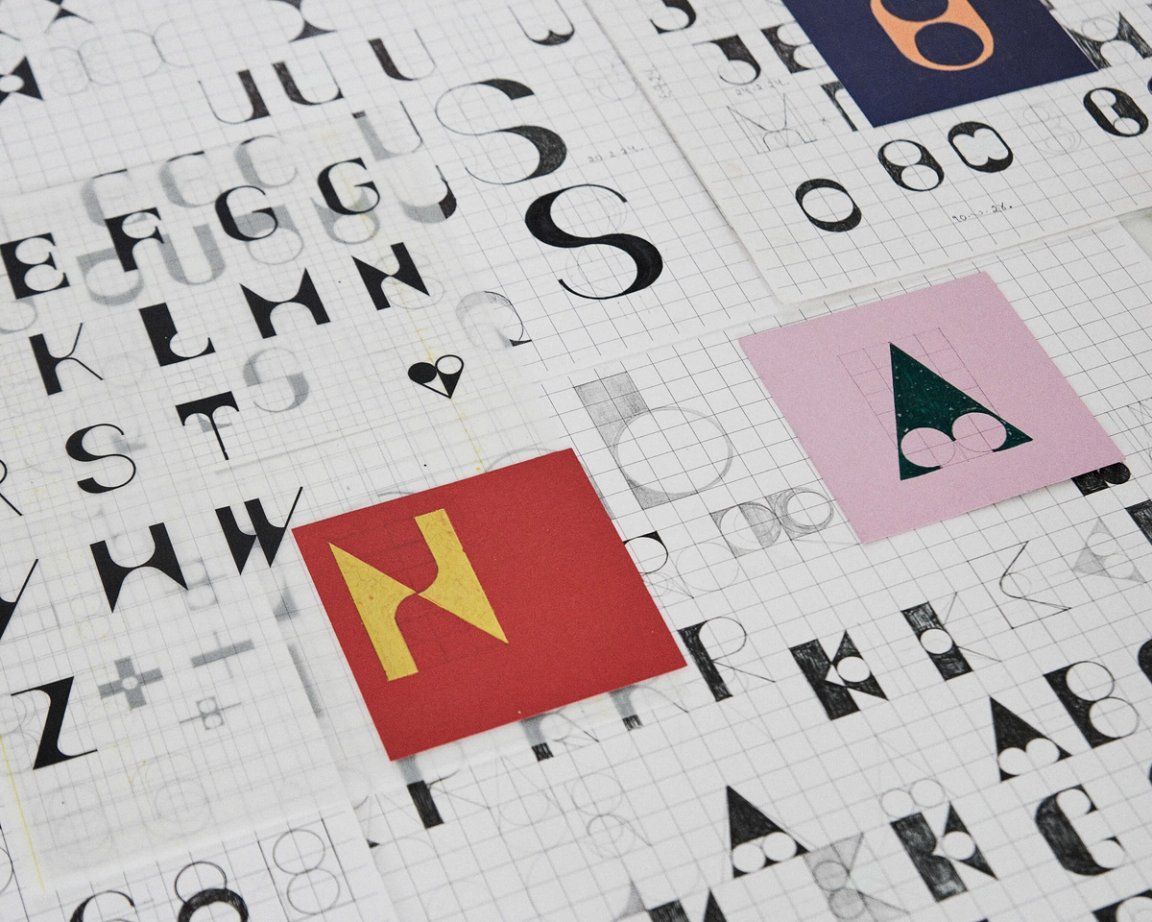
The typeface that Doshi has developed, excess, but rather integral to the finished object. and which is now being collected by the NGV.
As Doshi lays out the plans for her cabinet, which will travel to Melbourne’s National Gallery of Victoria (NGV) in September 2025 as part of the museum’s annual Women in Design Commission, her design partner and husband Jonathan Levien leans across the table. “In a lot of the work that we do, we explore objects in relation to space, and this cabinet has a very strong architectural approach to it – it’s an object, it’s a space, it’s a shrine,” he says. “It’s a historical reference to that tradition of traveling storytellers, where the doors would concertina open and the kaavad almost becomes a theatre.” Spread across Doshi’s collage, her kaavad’s doors have already been thrown open. Her cabinet’s lacquered purple and green doors, its blue and indigo doors, are folded aside to reveal a sliver of silver card, in which the designer’s face is reflected back dimly, its outline cloudy and fragmented in the lustre. “You open them up,” Doshi tells me, “and then they tell you the story.” But what story, I wonder, would you like to hear?
Story 1
Since founding her studio in 2000, having met Jonathan Levien five years previously at London’s Royal College of Art, Nipa Doshi’s work has often been misunderstood. “Without naming names,” she tells me conspiratorially, “some really important design companies have kind of dismissed my work as ornamental.”
It is, perhaps, an understandable mistake. The studio’s breakthrough 2007 Charpoy collection for Moroso emblazoned industrially produced daybeds with rich Gujarati embroidery, their cotton and silk mattresses stitched with checkerboard motifs from Chaupur, an ancient Indian dice game. “The game itself is like chess and led to the ‘Epic’ Indian war of ‘Mahabharata’, when kingdoms and wives were waged as prizes,” the designers write on their website. The 2014 Kundan cabinet for Paris’s Galerie Kreo, meanwhile, adorned its red lacquered wood with images of lotus flowers, mathematical symbols and precisely arranged geometrical mirrors, recalling the setting of gemstones in India’s Kundan jewellery tradition, as well as similar motifs “used to embellish the mud constructed interiors of nomadic homes in Kutch, often combined with mirror inlay bringing natural light into the space.” Doshi Levien’s furniture, textiles and lighting are always laden with cultural references of this kind, yet they are carefully folded into the structure of their designs such that the adornment achieves a kind of parity with material and form – the studio’s ornamentation is not aesthetic The typeface that Doshi has developed, excess, but rather integral to the finished object.
“My work has got pattern, it’s got texture,”2 Doshi concedes, “but it’s definitely not ornamental.” Instead, she argues, the embellishment characteristic of her work is a celebration of craft traditions, as well as the everyday visual culture that forms her aesthetic. The objects are abundant and plural in their references, she suggests, because so too is the world around us; her work’s exuberance can be understood as a form of realism, and one that cleaves closer to our actual experiences of everyday life than more minimalistic strains of industrial design that shun decoration.
In this sense, rather than ornamental, Doshi’s design is intended to reflect the visual plurality of ordinary life. “What I want to bring to my design,” she explains, “is the sense that there is beauty out there. If you want to see it, it’s always there.”
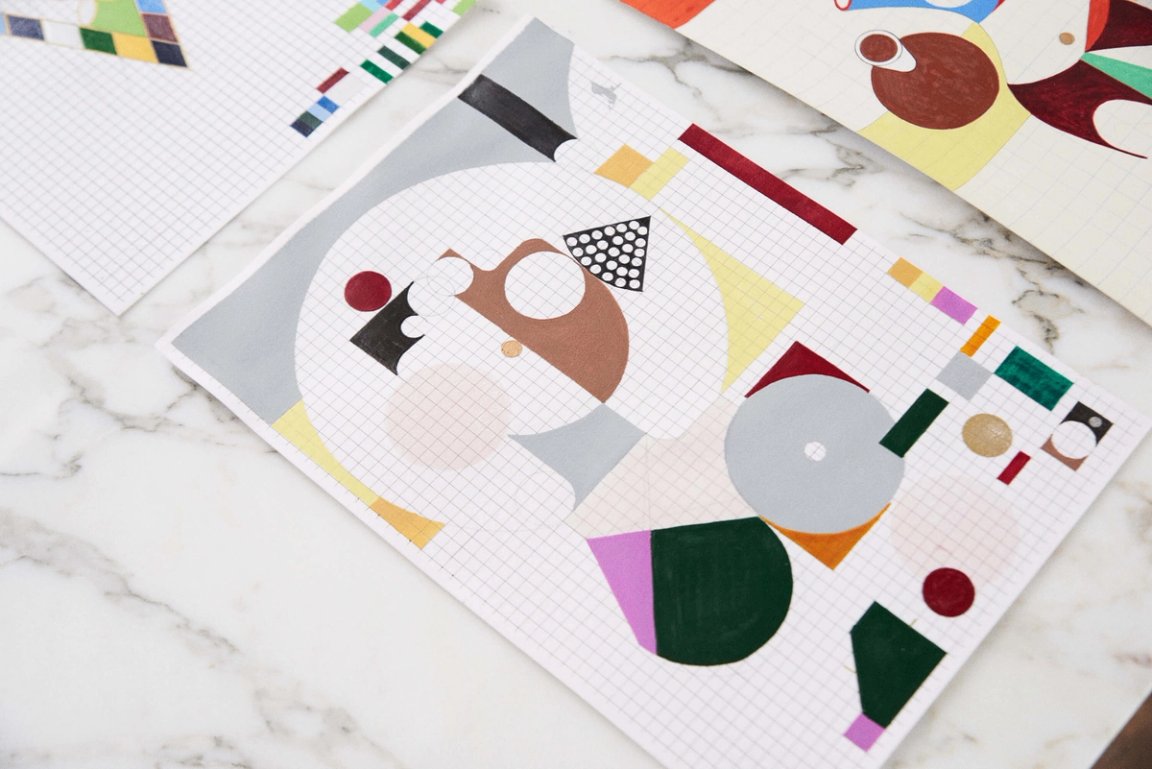
Drawings developed by Doshi for the Women in Design commission.
Doshi’s emphasis on complexity and visual richness in design is a position with no shortage of critical adherents, even if it is comparatively unusual in practice amongst contemporary furniture and lighting designers. “Art is a daughter of freedom, responding not to the demands of matter, but to the necessity in our minds,” writes essayist Becca Rothfeld in All Things Are Too Small, her 2024 critique of the ascendency of minimalism across multiple areas of culture. “For the present, need prevails, and bends a sunken humanity to its tyrannical yoke. Utility is the great idol of the age, to which all powers are in thrall and all talent must pay homage.” In contrast to this utilitarian approach, Rothfeld argues for an attitude towards both artistic endeavour and day-to-day existence that delights in profusion, excess, ambition and desire – the stuff of which life is made. “I dream of a house stuffed floor to ceiling,” she writes, “rooms so overfull they prevent entry; too many books for the shelves; [...] a kitchen crammed with cream, melting butter, sweating cheese. Clothes on the floor, shoes on the bed, blood rusted on the sheets, mud loaming all the carpets, and a table set for a banquet bigger than I could ever host. I want all this precisely because I do not need it.” Doshi’s design work may be refined and elegant, but it nevertheless understands something of this same impulse to encompass and contain the messiness and vibrancy of life.
“Whenever I’m creating anything,” Doshi tells me, “I think what I bring to it is my whole experience as a human being. Growing up in an art deco house in India, next to a paper cutting factory and a chaiwala and a bicycle workshop and cows on the road and Mercedes-Benzes and Vespa scooters and, you know – everything.” I notice that the table we are sat at is one of Doshi Levien’s own designs – Manzai, created in 2012 for their Das Haus installation in Cologne. It features a rectangle of Carrara marble, balanced atop pea green legs, which joins onto a hexagonal tabletop cast in terrazzo, perched on the tip of a metal stem. It’s a hybrid combination of shapes whose eclecticism, the designers hope, supports “the idea of parallel activities taking place” at once, encouraging different people to gather around its twin tops. It is, I think, a very Doshi Levien table.
Born in Mumbai, Doshi grew up in New Delhi before training as a designer in Ahmedabad – all cities steeped in the modernist movement and its impact on post-independence India. “My background is so modern,” she tells me, expressing surprise at the tendency for her work to be considered through the enduring suspicion of adornment present within much European design. “You know, my aunt’s house was designed by Le Corbusier’s assistant,” she tells me. “I grew up in Ahmedabad and had tea, God knows how many times, at Villa Sarabhai [Le Corbusier’s modernist villa]; and my mentor was BV Doshi [the Indian modernist architect]. I have a really rooted upbringing in modern design and, actually, if you look at my work, I’m always obsessed with the modernist grid and the logic of pattern.”
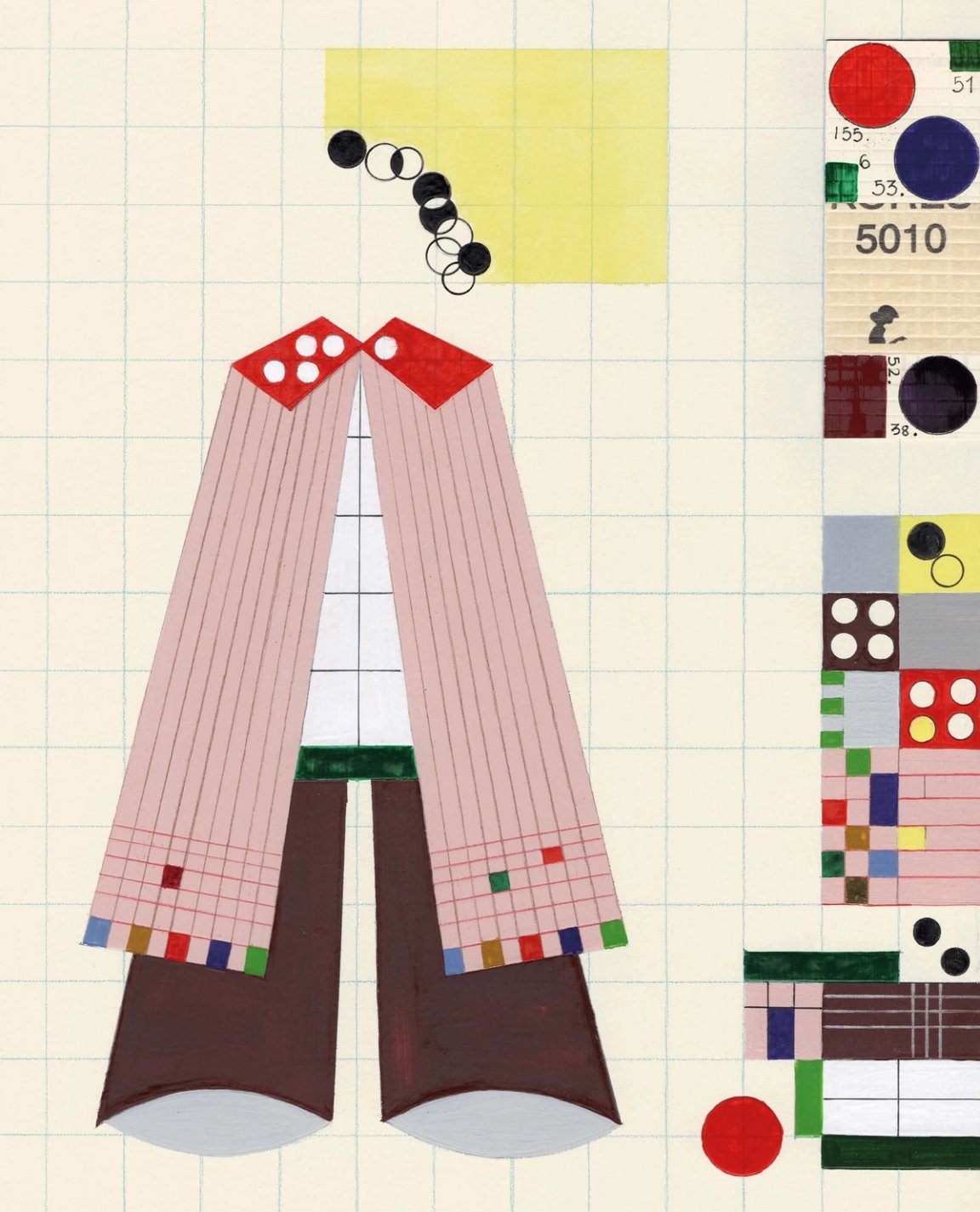
As part of the NGV commission, Doshi has undertaken a series of portraits of women who have played important roles in her life, with these drawings set to be displayed as maandna within the doors of her kaavad. Folding open her notebooks, all of which are school jotter style, printed with square paper, she shows me the drawings in process. Flitting in and out of the paper’s grid, Doshi’s portraits fragment into folds of fabric, the roll of a hip, spectacles, a tousle of hair, the curve of a neck, and are always, always, soaked in colour – colour in circles, in blocks, colour in lines that slip out of underlaying squares, sometimes washing palely over the paper’s structure, sometimes darkening to obscure it, bringing forth icons of women who cut briefly into figuration, before dissolving down into jewel-like, grid-like, abstraction. They are, Doshi says, fractal constellations of “all the women that I love”.
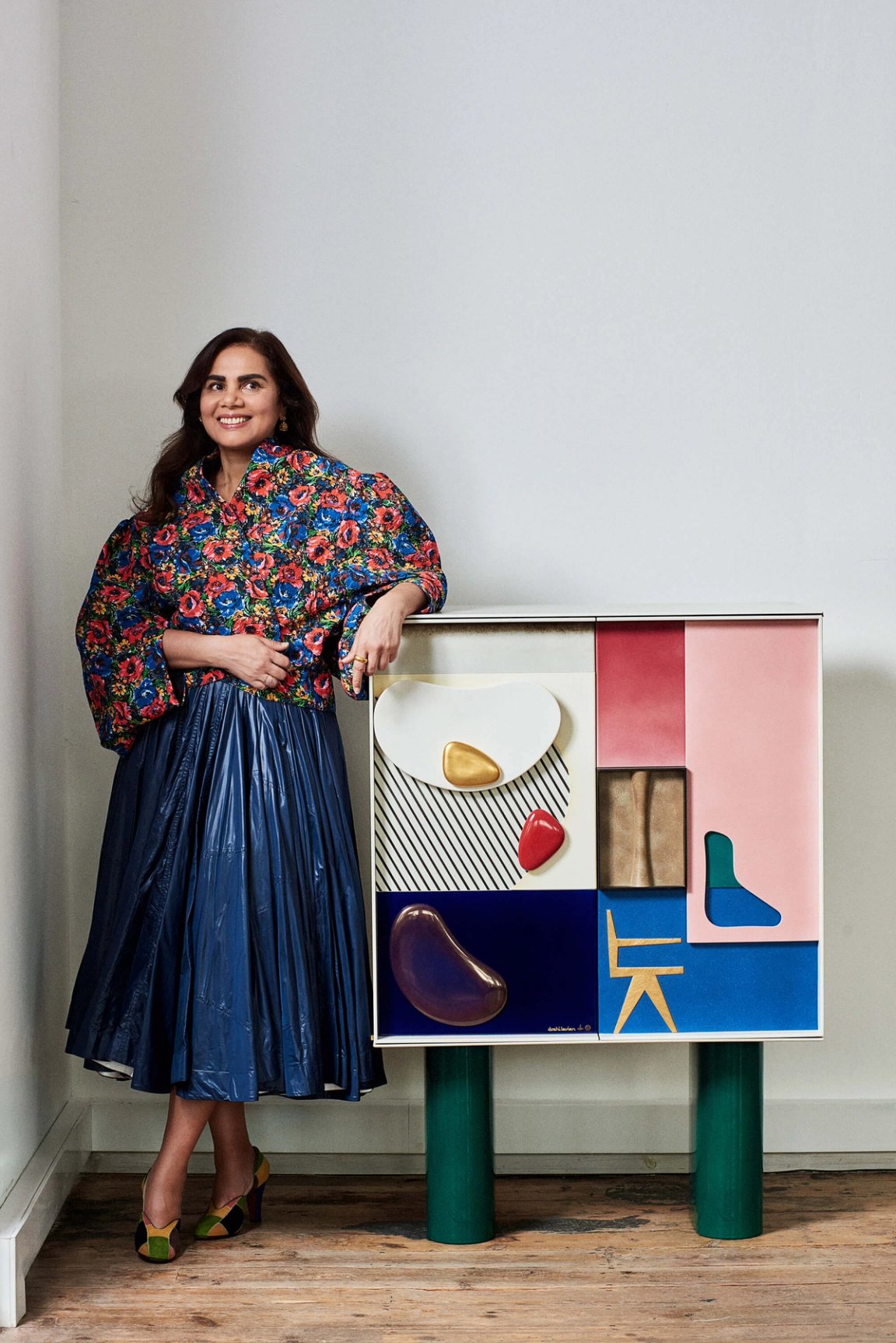
Nipa Doshi, her arm resting on her Le Cabinet, designed in collaboration with Manufacture Nationale de Sèvres.
Story 2
In 2015, the NGV founded its new Department of Contemporary Design and Architecture, tasking its inaugural curators Simone LeAmon and Ewan McEoin with assembling a permanent collection to support this. “Building a collection for a new department dedicated to the contemporary effectively means that you’re working with living designers, which is an extraordinary opportunity,” LeAmon tells me, speaking over Zoom from Melbourne. “As you can imagine, it required quite a strategy.”
The first stage of NGV’s approach, LeAmon says, was to conduct an audit of existing holdings. “I was curious to understand how many works by women we had in the collection that fell post-1980 and, you know, it’s always a bit of a sobering exercise when you do research like that,” she tells me. “What it revealed was that, gee, this is an area that perhaps we should put some particular energy into.” Happily, said energy was supplemented in 2022 through the arrival of funding from Mecca, an Australian cosmetics brand, allocated for the launch of Women in Design, a five- year initiative to commission new works for the NGV’s permanent collection from leading women practitioners.
I tell LeAmon that, being based in Europe, I hadn’t heard of Mecca before learning of the commission. “Oh, Mecca is an institution here in Australia,” she replies enthusiastically. “You know, people are going to a Mecca store not simply to purchase product, but to hang out, listen to music, spend time. People go there for the weekend!” This form of everyday cultural cachet, she says, has been translated into the brand’s M-Power social platform, which focuses on supporting initiatives surrounding gender equality, and which has generously supplied the funding required by NGV’s programme. For the past three years, the museum has committed this budget, and its curatorial expertise, to enable the development of original, large-scale artworks, with Nipa Doshi the fourth recipient of the commission3. “Once something comes into a state collection like the NGV, it never leaves,” LeAmon notes. “So we’re very mindful that these works will speak of this time for goodness knows how long into the future. We’re thinking about how we speak about design and architecture at this point in time.”
LeAmon is now, she tells me, eagerly awaiting the arrival of the cabinet in Melbourne, which is being shipped from its fabricators in France. She shows me WhatsApp pictures from Doshi of the kaavad under construction, its lacquer fresh and lustrous. The kaavad is glistening, lipped with solid wood, veneered, and washed in colour and gold leaf, with translucent glass tanks at each end to admit the light – a solution engineered by Jonathan Levien to translate the delicacy of Doshi’s collage into physical form. “It’s almost a jewel-like monolithic object,” he says, “which has been chamfered away to reveal the different colours and materials that Nipa intended in her collage.”
In this regard, Doshi’s cabinet is thoroughly in keeping with the history of the kaavad. “Some things reveal themselves, others stay hidden, still others one can dimly peer into,” wrote art historian BN Goswamy of the typology in his introduction to Sabnani’s Kaavad Tradition Of Rajasthan. “Panels slide; secret doors open; sights appear. There is a brush with history; social structures are explored; the meaning of it all sought to be unravelled.” With each photograph LeAmon shows me, new facets of Doshi’s kaavad emerge gleaming on the screen. At the risk of prompting the obvious, I ask what attracted the museum to working with Doshi. “We’ve always seen Nipa as being someone who can embed a really rich, layered narrative into her work,” she tells me, praising the studio’s commercial design for brands such as Kvadrat and Hay, but adding that it is their ability to break out of industrial design’s reputation for problem-solving and functionalism that specifically attracted the NGV to Doshi’s practice.
“Nipa can somehow speak to how design can be agile,” she says, “whereas many of us are taught that design is not agile, perhaps because our expectations of designers are of someone clinical and responsive to problems. But when we start producing design as cultural production, it is not necessarily aiming to solve a problem as such. Through Nipa’s work, we can talk about the relationship of storytelling and narrative and objects.”
Doshi’s collage for A Room of My Own
Story 3
“Is this good to talk about, Jonnie?” Nipa Doshi asks Jonathan Levien. “I think it’s a part of it,” he says.
When Doshi met Simone LeAmon in April 2024 to discuss the Women in Design Commission, she had recently completed treatment for cancer. “It was literally four weeks after my surgery,” she says, “and I think I just needed a gift.” The cabinet that resulted from this gift is, understandably, perhaps Doshi’s most autobiographical work to date, speaking of its designer’s life experiences and inner world, but also hinting at her desire to assert herself following a period of vulnerability. “I wanted to do a project that would liberate me from what I’d been through, but also give an opportunity to express what is valuable to me in design and what design means to me at a personal level,” Doshi says. “It was all about that freedom.”
Doshi’s emphasis on freedom finds an echo in Constellations, writer Sinéad Gleeson’s 2019 study of pain and illness, with the book touching upon the impact of healthcare on Gleeson’s own artistic work, as well as the manner in which personal identity can be confined and transformed through disease. “Art is about interpreting our own experience,” she writes. “Upon entering hospitals [...] our identity changes. We move from artist or parent or sibling to patient, one of the sick [...] A patient is not a person / A patient is a medicalised version of the self / A patient is a hospitalised double of the body / To become a patient is an act of transmutation, from well to sick, liberated citizen to confined inpatient.”
The NGV commission, Doshi says, provided an opportunity to move beyond this shrinking of the self described by Gleeson and instead serve as a form of self-assertion. “I just needed and wanted to do something bold,” she tells me. In this respect, the commission’s emphasis on platforming women, and working to circumvent the structural barriers that prevent their recognition within both design and wider society, crossed over into Doshi’s own experiences. “When you go through something like this, you’re afraid that you’re going to be written off if people find out you’re ill,” she says. “There are all these fears you have as a woman – you really have to be 100 per cent all the time, because you’re constantly being judged on everything. I think that did shape me and I now feel quite agitated and really impatient to do things, and to be myself.” LeAmon, in turn, tells me that although Doshi did not initially have the idea of creating a kaavad, she was instantly certain about one aspect of the commission. “What we found interesting,” she says, “was that Nipa had the title from the very beginning: A Room of My Own.”
Doshi’s installation is intended as a reference to the work of Virginia Woolf, whose 1929 essay A Room of One’s Own offers reflection on the “conditions [...] necessary for the creation of works of art,” exploring the social injustices that mean women have been systematically denied fulfilment of these. Woolf’s arguments are varied, but a central focus of the work is her determination to challenge society’s tendency to consider artistic pursuits in the abstract, and instead ground cultural production in the material circumstances through which it comes to be. “[To] write a work of genius is almost always a feat of prodigious difficulty,” Woolf notes. “Everything is against the likelihood that it will come from the writer’s mind whole and entire. Generally material circumstances are against it. Dogs will bark; people will interrupt; money must be made; health will break down.” The best recipe for ensuring good work, she concludes, is “to have five hundred a year and a room with a lock on the door [...] that five hundred a year stands for the power to contemplate, that a lock on the door means the power to think for oneself”.
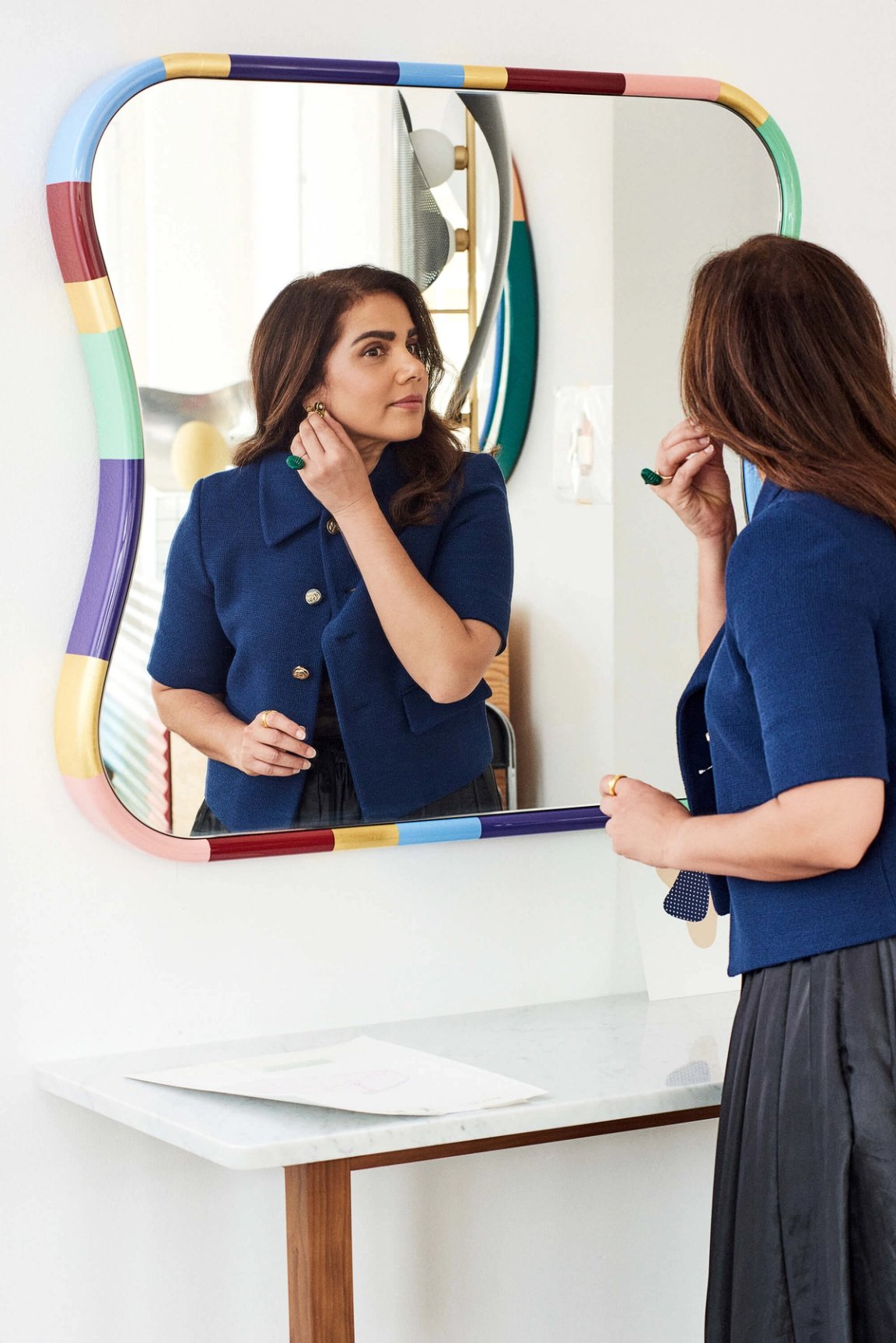
Doshi reflected in the studio’s Kinari mirror for Galerie Kreo
In this regard, Doshi’s A Room of My Own echoes Woolf’s ideas through its choice of typology – the cabinet may serve as a tribute to the cultural history of the kaavad, but it is also intended to function as a dressing table and writing desk. Doshi and Levien have engineered the piece such that its two sides are mirror images of one another, with one opening up to reveal the kaavad’s maandna, the other offering a mirror for dressing and a flat surface for work. “It’s perfectly functional,” Doshi explains, “And although there’s a very strong personal narrative in it, the cabinet has a right to exist without me talking about it. It’s not just a shrine, but a space to write and nourish the mind.” Like Woolf, however, Doshi acknowledges that such work does not take place in a vacuum – her drawings are intended to reflect the different women who have supported the designer throughout her life, offering composite portraits of the “extraordinary ordinary women” who have facilitated her work.
One drawing, Loud Ladies, references Doshi’s childhood, when women in her neighbourhood would often gather together, “all in colourful saris, everyone talking at the top of their voices – and yet with so much generosity in that gathering.” Another honours entrepreneurship, referencing Doshi’s aunt who founded an embroidery workshop in Ahmedabad that produced work for Hermès and Issey Miyake, as well as launching a charity to provide women with legal aid. Also present in one of the drawings is Mahatma Gandhi’s khadi, a spinning wheel that became a symbol of Indian national autonomy and liberation during the anti-colonial Quit India Movement of the 1940s. “I don’t want to say that any of these drawings are a particular person, because I feel that I meet interesting women every day,” Doshi says, “but what I was looking for were qualities of kindness, fearlessness – things that I admire and love in women.”
From amongst her drawings, Doshi pulls out another work in progress that deals in glamour, referencing the Bollywood star Zeenat Aman, whose films Doshi grew up watching. “There is something to do with sartorial splendour that I like,” Doshi acknowledges. “When someone takes care to put an outfit together, it gives me so much pleasure. I want to celebrate beauty, and what you wear, as an expression of respect.” The panel referencing Aman is the most figurative of all Doshi’s drawings, the body it depicts resisting fragmentation into the grid, instead luxuriating in curves and draped fabrics. “Zeenat was very progressive, independent and absolutely gorgeous – stunning – so there’s a bit of sexiness, which is part of my cabinet too,” Doshi says, laughing. “It’s not all worthy, you know.”
Although Doshi creates similar drawings and collages as starting points for all of her design work, A Room of My Own is the first time that these elements of her process are being displayed as part of a finished object. It has been, she acknowledges, a chastening decision to make (“I was initially so nervous about it and there was a kind of imposter syndrome,” she says. “Who am I that my drawings are worthy to be shown?”), but one that feeds into an increasing sense of liberation around her practice. To accompany the cabinet, Doshi has developed her own typeface, which will likewise enter NGV’s permanent collection – the first that the museum has ever collected. Levien shows me the designs in process for Doshi’s letterforms, whose shapes swoop outwards in thick curves, before locking back into the grid on which they have been drawn. “Each letter is like an object, aren’t they?” he notes admiringly, highlighting the number nine, whose composition resembles a light switch, ready to be flicked on. “They somehow look like they’ve been milled or drilled.” Levien suggests that a typeface was a natural extension of the cabinet (“As a designer, you could never write the name ‘A Room of My Own’ without designing the font itself”), whereas Doshi bills it as part of a wider desire to more broadly define the conditions through which her own work comes to be. “As a designer, you always say, ‘I’m an industrial designer,’ ‘I’m doing textiles,’ ‘Doing colour,’ ‘Lighting,’ ‘Design for God knows what else,’” she says, “But I feel that if you’re a designer, you can apply yourself to anything. I don’t see why doing a typeface is any different from doing an engineered product, because you are creating a system, you’re creating a logic – I now feel that I can design anything.”
Amongst this professional expansion, however, there is one element of contraction within the NGV project. Originally, Doshi had envisaged the creation of an entire environment, with the cabinet accompanied by a daybed and other furniture pieces. “I always have a tendency to want to do more,” Doshi says, “but it was Jonathan who said, ‘No, Nipa, this cabinet is enough; you don’t have to complicate things.’ That’s really where Jonathan and I work well together – he has always been able to hone in on the essence of an idea.” Although it is Doshi’s name on the commission, and her creative direction for the project as a whole, she is careful to point out that the project has been developed in the same manner as all of the studio’s work – the two designers working in lockstep to shape one another’s ideas, and in turn the objects through which they are made manifest.
“I think it’s all about potency,” Levien explains, showing me a cardboard model the studio has made to highlight the manner in which Doshi’s kaavad will stand alone in the centre of NGV’s gallery. “If you’re able to say something within one piece, and get all the complexity of that beautiful idea into it, then that’s stronger.”
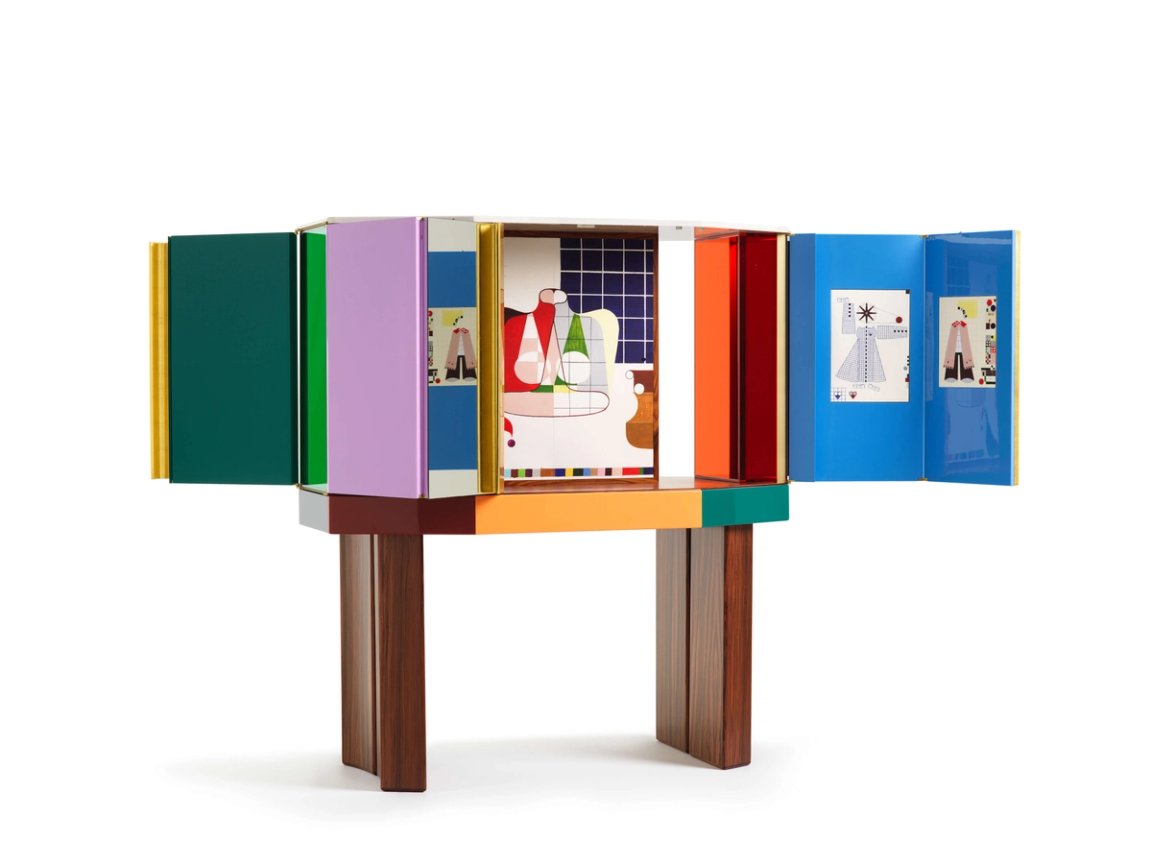
The A Room of My Own cabinet (image: courtesy of NGV)
Story 4
When I speak with Simone LeAmon, I raise the fact that A Room of My Own presents an issue for both writers and curators – the work condenses so many disparate meanings into itself, and is so personal to its creator, that it’s difficult to know where to begin in explaining it. The cabinet tells the story of Nipa Doshi, but also contains stories about representation in design, visual culture, everyday circumstance impacting on creative freedom – it is, as Rothfeld might have it, “a table set for a banquet bigger than I could ever host.”
“What’s interesting about Nipa,” LeAmon replies after a pause, “is that she wears her heart on her sleeve. She’s a talent who is so transparent about what drives her, and what motivates the design, which is very much about her inner world.” The kaavad, she says, is an expression of the capacity for design to exist as story, and an assertion of the designer’s capacity to be something more than, or something different to, a straightforward problem-solver working to a brief – it can also be a means of processing the world around you, and transforming those perceptions into new forms of material representation. “I think Nipa helps us understand that dimension to design far more so than many other designers,” LeAmon continues, “but, having said that, don’t you think when you work with any architect or designer, their work is always, in some way, informed by their inner world?” In contrast to the work of contemporary artists, she suggests, design continues to struggle to frame its output as emotional or personal in addition to its more functional elements. “It’s all very well [to think of designers] as being motivated by global issues and, you know, big wicked problems,” she says, “but at the end of the day, if we understand more about the individual, then we can better understand what’s driving the practice.”
In this, LeAmon seems to be correct. Any work of design is shaped by its creator’s outlook, history and circumstances, as well as the material conditions through which their work came to be. “It may seem a brutal thing to say, and it is a sad thing to say,” Woolf wrote nearly 100 years ago, “but, as a matter of hard fact, the theory that [...] genius bloweth where it listeth, and equally in poor and rich, holds little truth.” All design work is borne from a social context, and shaped by the way in which designers are buffeted by that context in their everyday lives. “I often think that design, any design, is the result of more things that we don’t say than things that we do,” LeAmon tells me, “which is a beautiful analogy for the world around us, because there is just so much powerful latent information and forces that are shaping the world that we live in.”
This, Sabnani observes, is the story of the kaavad too. The shrine’s form, she says, “has fascinated designers and artists – drawn them both to the form and the idea.” The kaavad’s richness and complexity suggests “the idea that it must have a specific purpose to serve,” but, Sabnani adds, “[what] is the purpose of this object and who is it for?” In Doshi’s case, the answer seems refreshingly ambiguous. “Plurality and openness are important to me,” she tells me, “and it’s a multifaceted cabinet, because we’re all multifaceted as human beings and women. I really wanted to embody that idea in the object, because the commission is quite open – it gives you complete freedom to express your voice.” The resultant object, as Sabnani might note of its kaavad forebears, delights in the ambiguities of what that voice might be, and what it might want to say. “On the one hand, the object [seems] simple and disarming in its frank revelations of what [lays] within,” Sabnani writes. “On the other, it [seems] to hide secrets and meanings that [defy] comprehension of the casual observer.”
Oli Stratford is the editor-in-chief of Disegno.
Philip Sinden is a Scottish-Pakistani photographer based in London.